Forces Shaping Education: Roundtable Notes & Key Takeaways
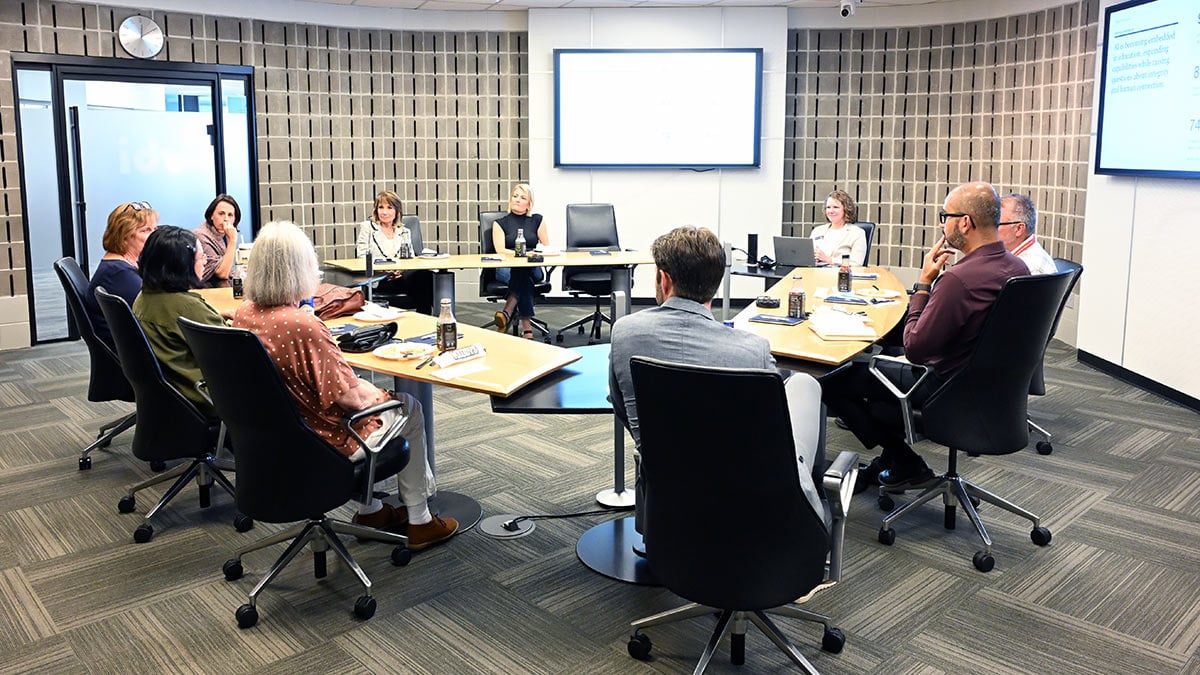
Steelcase opened the discussion by sharing its educational research framework focused on three key outcomes:
- Empower: Supporting student agency, independence, and ownership of learning
- Engage: Creating active, inclusive environments that foster participation and collaboration
- Expand: Encouraging lifelong learning and continuous skill development
The discussion was also informed by Steelcase's use of foresight methods, which examine emerging trends and signals of change to better understand how learning may evolve in the future. Rather than predicting a singular future, foresight helps institutions prepare for multiple possibilities and design spaces flexible enough to adapt.
Want to take a deeper dive?
Download the presentation from our Education Roundtable for the full research, discussion points, and insights.
Discussion Question
How are the forces shaping education changing when, where, and how learning happens?
Learning Is Becoming More Fragmented
One participant noted that students approach learning differently than they did even a few years ago.
- Some students fully embrace AI and technology-enabled learning.
- Others continue to prefer collaboration, discussion, and traditional learning methods.
- Faculty are increasingly challenged to support multiple learning styles within the same classroom.
One concern raised was that AI may be reducing natural conversation and collaboration between students. While access to information has never been easier, proving understanding and demonstrating the process behind the work has become increasingly important.
A recurring thought throughout the discussion was:
"Students can often get the answer, but can they explain how they got there?"
Collaboration Remains Important
While AI dominated the conversation, participants repeatedly emphasized that collaboration and peer learning remain essential.
One participant shared that within its design programs, students are collaborating more than ever.
Several institutions discussed how collaborative learning experiences continue to create value, even as technology changes the classroom experience.
This reinforces the need for campuses to provide spaces that support both independent work and group interaction.
Student Support Needs Continue to Grow
Multiple participants discussed increased demand for:
- Disability services
- Student support programs
- Mental health resources
- Spaces for focused and private work
Institutions are seeing greater diversity in student needs and learning preferences.
As a result, adaptability was highlighted as a major consideration when planning future learning environments.
Campuses increasingly need spaces where students can:
- Focus independently
- Collaborate with peers
- Meet privately with support services
- Feel a sense of inclusion and belonging
Keeping Students on Campus Longer
One participant shared that efforts in Lincoln are increasingly focused on keeping students engaged within campus facilities throughout the day.
As students spend more time in campus buildings, expectations for the environment expand beyond traditional classrooms.
Institutions are evaluating how spaces can support:
- Studying
- Collaboration
- Social connection
- Wellness
- Informal learning
The building itself is expected to provide more experiences and accommodate more activities than ever before.
The AI Conversation
How Are Institutions Using AI?
The conversation revealed significant experimentation and innovation across education, along with thoughtful discussion about the challenges AI presents for students, educators, and the workplace.
AI in Training & Education
One participant shared how AI-powered tools are being used to create more effective and realistic training experiences. Benefits discussed included:
- More efficient training
- More realistic learning scenarios
- Better preparation for real-world situations
At the same time, participants raised concerns about AI's potential impact on critical thinking.
One participant observed that while people can now access the right answer almost instantly, they may not always understand why the answer is correct. The group noted that this challenge extends beyond education and into the workplace.
AI Initiatives in Higher Education
Participants also shared examples of how higher education institutions are responding to the rapid growth of AI.
Initiatives discussed included:
- Developing degree programs focused on Artificial Intelligence
- Establishing AI policies and ethical guidelines
- Encouraging student innovation and experimentation with AI
One interesting observation was that students often understand and adopt AI faster than many of the organizations that will eventually employ them.
Faculty are also navigating how to balance traditional teaching methods with evolving learning preferences. As students increasingly expect different ways to learn, institutions are exploring multiple pathways to help students succeed.
AI as a Learning Partner
A common theme emerged around viewing AI not simply as a threat, but as a potential partner in the learning process.
Participants discussed AI's potential to serve as:
- A learning assistant
- A brainstorming partner
- A collaborator
- A "team member" within the learning process
Examples included instructors creating custom chatbots that can:
- Answer student questions
- Guide learning
- Provide additional support outside the classroom
- Help faculty understand what students are asking and where students may be struggling
The overall sentiment was that AI should enhance learning—not replace it.
How AI Is Influencing Campus Spaces
The conversation also explored how AI and evolving learning methods may influence the design of educational environments.
Participants discussed moving away from classrooms where every student sits behind a fixed computer. Challenges with these environments can include:
- Reduced collaboration
- Less interaction between students
- Greater difficulty for instructors to engage the entire room
One participant shared how lecture hall designs are beginning to evolve to include:
- More collaborative tables
- Flexible layouts
- Greater opportunities for student interaction
As learning becomes increasingly digital, participants agreed that physical spaces may need to work even harder to support human connection, collaboration, and engagement.

Funding, Enrollment & Expectations
Steelcase shared national trends showing:
- Approximately 13% decline in public funding per student
- Approximately 37% increase in tuition per student
Despite these financial pressures, many participants reported that enrollment is growing and, in several cases, at or near all-time highs.
This created an interesting tension in the discussion.
While funding data suggests increasing pressure, institutions are simultaneously serving more students than ever.
Participants noted that student expectations continue to rise around:
- Technology
- Learning environments
- Campus experiences
- Support services
At the same time, employee expectations are rising as well.
Several attendees questioned whether changing workplace and campus expectations are a lasting effect of the COVID era, creating new demands that institutions must continue to address despite budget constraints.
Growing enrollment is also driving facility updates, including:
- Classrooms
- Common areas
- Gathering spaces
- Student lounges
- Lobby and collaboration environments
Emerging Trend: Micro-Credentialing
Another notable topic was the growth of micro-credentialing and alternative education pathways.
One participant shared that demand for shorter-form learning opportunities and skill-based credentials is contributing significantly to enrollment growth.
This reflects a broader shift toward lifelong learning, where individuals seek targeted education throughout their careers rather than relying solely on traditional degree programs.
Final Takeaways
A few consistent themes surfaced throughout the discussion:
- AI is creating both opportunity and uncertainty.
- Critical thinking remains as important as ever.
- Students increasingly expect flexibility in how they learn.
- Collaboration and human connection continue to matter.
- Demand for student support services is growing.
- Institutions face increasing pressure to do more with limited resources.
- Enrollment remains strong, even amid funding challenges.
- Campus environments must become more adaptable to evolving needs.
- Lifelong learning and micro-credentials are becoming increasingly important.

Thank You for Joining the Conversation
Thank you to everyone who shared their insights and helped make this roundtable a valuable conversation about the future of education.
Want to learn more? Connect with me to explore Education solutions, upcoming Roundtables, or CEU opportunities.
Max Huerter
Business Development Manager